

The Startup Dilemma: Speed vs. Perfection
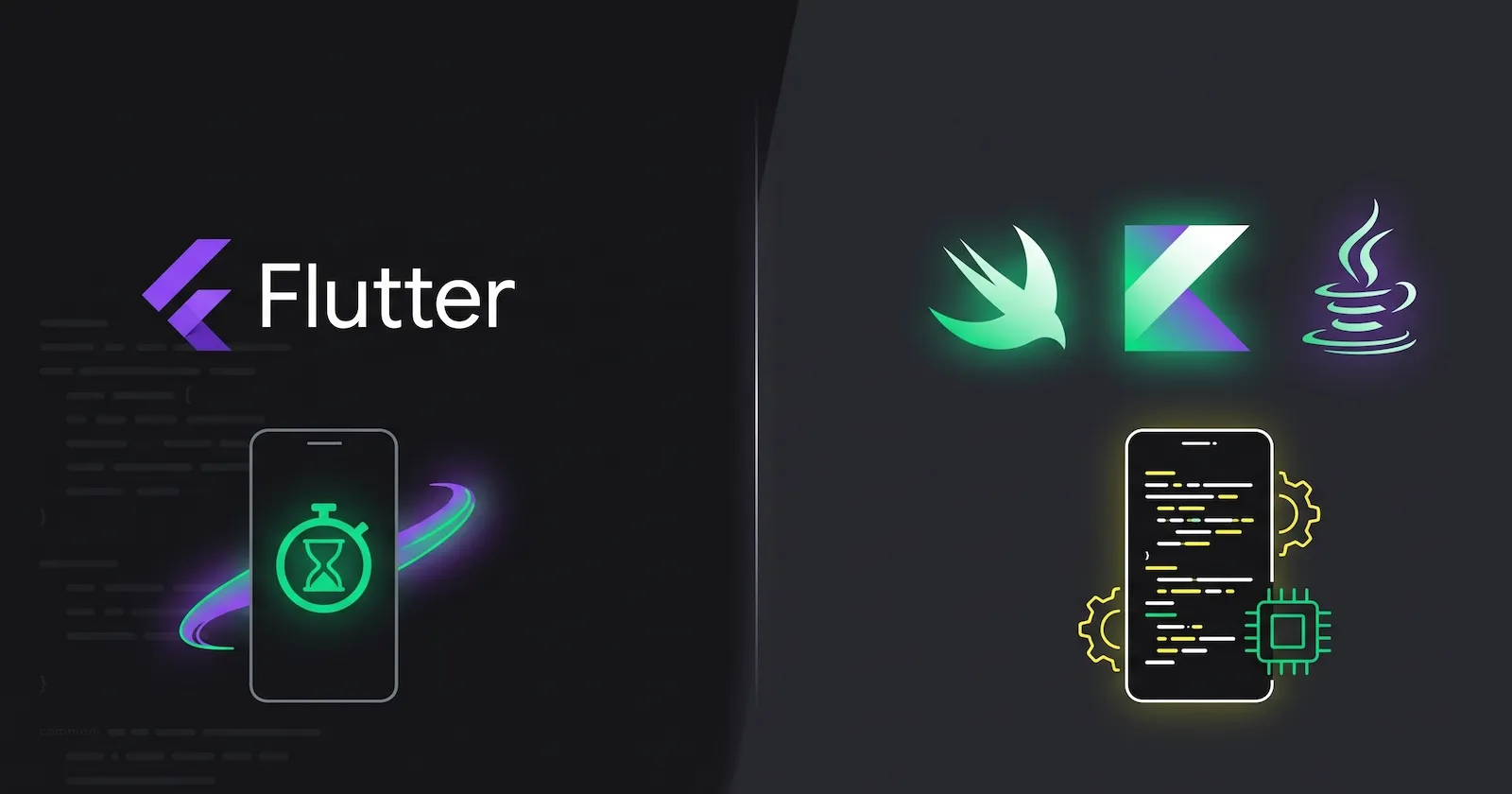
For an early-stage startup, every day spent in the development cycle is a day away from customer feedback, revenue, and product-market fit. When building a mobile application, the choice of technology stack is one of the most consequential decisions a founding team makes. Should you go native, with Swift for iOS and Kotlin for Android, or leverage a cross-platform framework like Google's Flutter? This decision hinges on balancing immediate time-to-market (TTM) needs against long-term architectural stability and performance requirements.
The Argument for Flutter: Accelerating Innovation
Flutter has emerged as the go-to framework for startups looking to iterate rapidly. By providing a single codebase that compiles into high-performance machine code for both iOS and Android, it effectively halves the development workload for UI/UX teams.
The Efficiency Factor
In the validation phase, your product requirements change daily. Flutter’s 'hot reload' feature is a game-changer for developer velocity, allowing engineers to visualize changes in real-time without re-compiling the entire application. This shortens the feedback loop between design changes and technical implementation, which is essential when testing hypotheses with early adopters.
Economic Impact
Maintaining two separate native codebases requires a larger team—two sets of developers, two backlogs, and double the QA testing effort. By standardizing on Flutter, a startup can manage with a leaner team. This translates to lower burn rates and allows founders to reallocate capital into marketing or backend development, which are often more critical to survival in the seed stage.
When Native Beats Cross-Platform
While Flutter is impressive, it is not a silver bullet. There are scenarios where native development is not just preferred, but necessary. Understanding these 'limitations' is crucial for technical due diligence.
Deep Hardware and SDK Integration
If your startup is built around advanced hardware interactions—such as complex Bluetooth Low Energy (BLE) peripheral handling, high-frequency sensor processing, or heavy low-level image processing—native development offers a shorter path to stability. While Flutter allows for 'Platform Channels' to talk to native code, this layer adds complexity. If you spend 50% of your time writing native wrappers to support custom hardware, you lose the primary economic benefit of Flutter.
The 'Uncanny Valley' of Performance
For 95% of business applications—marketplaces, social networks, SaaS tools, and content platforms—Flutter provides performance that is indistinguishable from native. However, if your application requires extremely high-fidelity animations, complex 3D rendering, or extreme memory management, native frameworks provide finer control over the GPU and memory allocation. Native platforms ensure that OS updates, such as new iOS UI paradigms or Android's system behaviors, are supported immediately, whereas Flutter applications rely on the framework team to provide updates.
Evaluating Time-to-Market (TTM) Trade-offs
In the startup world, Time-to-Market is the North Star. However, TTM is not just about the launch date; it is about the cost of maintaining the software post-launch.
The Cost of Refactoring
Startups often view Flutter as a 'bridge' technology—build it fast in Flutter, then rewrite it in native later. We advise caution here. If your product gains traction, the cost of rewriting a complex, established codebase is often higher than the original development cost. You lose the 'institutional knowledge' built into the original codebase and risk introducing bugs during the transition. If your product is likely to scale significantly, build for the architecture you want to keep, not just the one that gets you to version 1.0.
Developer Availability
One of the hidden benefits of Flutter is the talent ecosystem. Hiring experienced mobile engineers is notoriously difficult and expensive. Because Flutter uses Dart, which is relatively easy for developers coming from Java, JavaScript, or C# backgrounds to pick up, startups often find it easier to scale their engineering teams compared to hunting for niche Swift or Kotlin experts.
Making the Right Call for Your Startup
To synthesize, your decision should not be driven by framework loyalty but by the specific nature of your product. If you are building a CRUD-heavy application or a user-facing platform that relies on standard OS interactions, Flutter is the clear winner for cost-efficiency and velocity. It provides the necessary parity with native expectations while allowing you to move with the speed of a startup.
Conversely, if your core value proposition involves proprietary hardware integration, extreme low-level resource management, or deeply specialized system-level features, the native route will save you from the headache of maintaining complex custom plugins.
Conclusion: Strategic Alignment
The choice between Flutter and native is a trade-off between the flexibility of rapid development and the specialized control of platform-specific engineering. For startups in the validation phase, the ability to pivot, iterate, and reach a wider audience with a consistent experience across platforms usually tilts the scale toward Flutter.
At Appventura, we advocate for a pragmatic approach: build the core value in the technology that allows your team to focus on the customer, not the build process. If you can deliver a high-quality product using Flutter, you are already one step closer to the market. Remember, users care about the value your app provides, not the language in which it was written. Choose the path that ensures your product reaches them as quickly and reliably as possible.